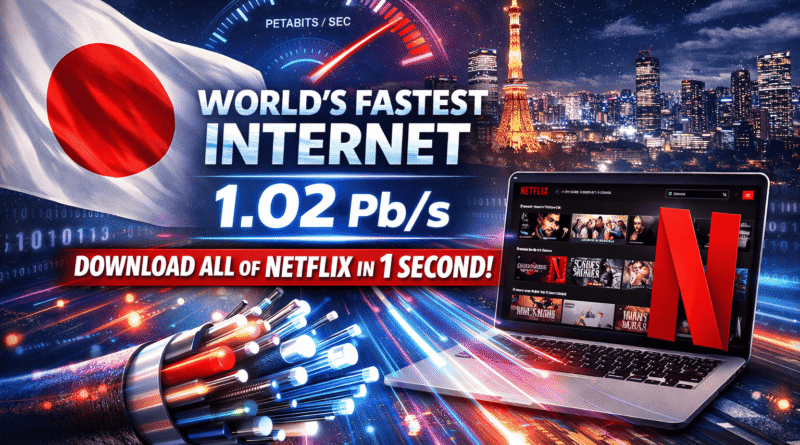
Japan Breaks World Record for Fastest Internet Speed
It is in a time when digital experiences are shaping how we work, play and connect and Japan has just taken internet performance to a place that no one could have thought possible. The latest world record internet speed of 1.02 petabits per second (Pbps) has been recorded in Japan and is incredibly fast to the point of being able to download the entire Netflix library in one second. Yes, you read that right! It is not just a technological advancement but is a breakthrough that will change the very definition of ultra-high-speed internet.
This exhaustive article will take a closer look at what this world record entails, how it was accomplished, how the world internet speed is doing, and what connectivity as a whole holds in store in the future as a consumer or enterprise all over the world.
The Record-Breaking Feat: 1.02 Petabits Per Second
In July 2025 scientists working at the National Institute of Information and Communications Technology (NICT) in Japan in conjunction with other partners including Sumitomo Electric industries declared a milestone of optical communication technology. Using standard size optical fiber cables, they recorded a standard-size optical fiber 1.02 petabits per second over a distance of about 1,808 kilometers.
To put this into perspective:
- One petabit = 1,000,000 gigabits.
- This throughput is estimated as being approximately 1,020,000,000 Mbps – this is almost 4 million times greater than the average broadband in the U.S.
- With this speed it would be possible to download huge collections of data such as the complete content library of Netflix or even Wikipedia within a second.
This is the highest internet speed that has been ever measured and it is far much higher than the traditional broadband as well as the fastest 5G commercial networks.
What Does 1.02 Petabits Really Mean? Breaking Down the Numbers?
Now we shall put these phenomenal speeds in common language:
Internet Speed Comparison (Mbps vs. Pbps)
| Metric | Typical Home Broadband | Japan’s Record Speed |
|---|---|---|
| Download Speed | ~ 200–300 Mbps (US/EU average) | 1,020,000,000 Mbps (1.02 Pbps) |
| Relative Speed | Baseline | ~4,000,000× Faster |
| Netflix Library Download | Minutes | ~1 second |
Data transfers at a fantastic scale, with 1.02 petabits, but now it is time to go beyond the personal consumption and to data centres, AI clusters, and world wide backbone.
How Japanese Researchers Made It Happen?
The record was not made by wireless technology such as 5G or satellite, but made by fiber-optic connections, the standard of transmission of ultra-fast low-latency data.
Key Breakthrough Elements:
1. Multi-Core Fiber Cable, Special.
The team utilized increased optical fiber a 19core fiber, i.e. 19 paths of light passing through one fiber strand.
2. Normal Fiber Interchangeability.
This speed utilized ordinary fiber infrastructure as big as the cables already being implemented around the globe, unlike experimental systems, which need exotic materials.
3. Long-Distance Transmission
It was not only rapid, but also long-range. The transmission which was made over a distance of 1,808 km proves that even short-lab distances are not confined to such speeds.
These developments are an indicator that someday ultra-high-speed internet may be incorporated in the backbones of the world network and transmission of data internationally would be greatly enhanced.
How This Compares to Today’s Real-World Internet?
The average internet speeds in the world were impressive and modest in comparison before Japan set this world record.
Mean Broadband Speeds (2025) around the globe.
- United States: ~274 Mbps
- Singapore: ~336 Mbps
- United Arab Emirates: ~310 Mbps
- Japan: ~212 Mbps (normally ranked within the 19 th in standard broadband)
In this respect, even the 1.02 petabit milestone is millions of times faster than the daily internet access of both consumers and companies.
Download Netflix’s Entire Library in One Second?
The statement that at this speed, it is possible to obtain all the content of Netflix in approximately one second is one of the most eye-catching headlines, and quite justifiably so. The principle is rooted in the amount of data Netflix contains (movies, TV shows, 4K streams, etc.) and the potential throughput of 1.02 petabits per second.
In practical terms:
- Providing that the entire library of Netflix was around 10,000-12,000 movies, this speed would theoretically wirelessly transfer them in real-time.
- What would take hours on a normal home broadband would occur in one beat of the heart.
Although this is mostly just a fictitious visual statement, it serves to point out how monumental the speed is.
Implications for Technology & Innovation
It is not only about speed that the leap of megabits to petabits will make it possible to realize the next generation of technology.
1. Cloud Computing & Big Data
There would be an option of transferring a mass of data between data centers in real-time, speeding up machine learning, analytics, and cloud performance.
2. Edge AI & Artificial Intelligence.
Fast pipelines imply that AI models can be trained on geographically dispersed resources that are not bottlenecked.
3. Real-Time Gaming & AR/VR
The cloud gaming latency free experience and complete immersion with VR/AR could become the norm.
4. Autonomous Vehicles & IoT
Interconnected networks with real-time information in cities and even nations would enhance safety and efficiency.
Current Limitations: Lab vs. Consumer Reality
Although this record of Japan internet speed is revolutionary, it is necessary to explain:
- This speed was not done in the actual commercial consumer networks, but in the laboratory conditions.
- The average user all over the world continues to use broadband speeds of the hundreds of Mbps range.
- The infrastructure of the backhaul, local networks, and hardware of the devices need to change to be able to use petabit speeds in full.
Nevertheless, the experiment demonstrates the obvious trend in new improvements of infrastructure in the future.
How Japan’s Tech Leadership Impacts Global Connectivity?
Japan has led the research on high-speed internet since the first optical fiber technology to the implementation of 5G.
The world implication of this innovation is:
Futuristic Networks Standardization
The standard fibers that are compatible will allow easy integration into existing networks.
Competitive Edge in AI & Data Infrastructure
The existence of a petabit speed backbone network in countries will draw industries that require high amounts of data.
Outside of Broadband Innovations
The new speed levels will lead to a quantum communication, cybersecurity and distributed network innovation.
What This Means for Premium Countries?
To developed digital economies such as the United States, Canada, UK, EU, Australia, Japan and South Korea, the blow is fatal:
Quickened Research and Development
The access and movement of big quantities of data can be done in real time by scientists, engineers, and innovators.
Better Digital Services
Benefits of using lower latency and augmented throughput are seen in streaming, telemedicine, remote work and digital education platforms.
Enhanced Cybersecurity
The speedy networks are capable of minimizing the vulnerability periods and enhancing the encrypted communications.
The Future: From Petabit to Exabit and Beyond?
And already with this record experts are asking: What’s next?
- Exabit speeds (10^18 bits/sec)
- Quantum internet trials
- Hybrid networks on land and on the air.
- International low latency backbone routes.
With the ever-growing data consumption, petabit network speeds might be the platform of the next generation of connectivity.
Frequently Asked Questions (FAQs)
1. What is the fastest internet speed in the world right now?
The maximum internet speed was 1.02 petabits per second (Pbps) by Japanese scientists. This is a current speed record of the world and is far much faster than that of the commercial internet speed offered to consumers in the United States, Europe, or Asia.
2. Did Japan really create internet fast enough to download all of Netflix in one second?
Yes – in theory. The Japanese internet speed of 1.02 petabits per second is the fastest in the world, and this is fast enough to stream the entire Netflix content library in one second. This is done to illustrate the scale other than actual use by consumers.
3. Is Japan’s fastest internet speed available to the public?
No. This velocity was realized in a controlled laboratory set up in experimental optical-fiber technology. Internet connectivity to consumers and businesses is not yet at that level of providing petabit-level speeds.
4. How does Japan’s internet speed compare to the United States?
The internet speed in Japan is approximated to be about four million times as fast as the average U.S. internet speed, estimated at 200 -300 Mbps (Mega bits) when used by home users.
5. What technology was used to achieve this internet speed?
Researchers used the high-technology multi core technology of optical fiber with 19 cores of light transmissions and that allowed very large numbers of data to be transmitted at any one time through a single fiber cable.
6. Will petabit internet replace 5G or 6G?
No. Petabit internet speeds are used as backbone infrastructure, data center and research networks. Wireless consumer technologies like 5G and 6G will be offered and will indirectly gain advantages of faster backbone networks.
7. Why is Japan leading in ultra-high-speed internet research?
Japan has heavily invested in telecommunication research, fiber-optic and next-generation networking technologies and had been investing in these technologies since long. Organisations like the National Institute of Information and Communications Technology (NICT) continually exceed the speed limits in the global internet.
Conclusion: A New Era of Connectivity
The phenomenon of Japan being able to reach 1.02 petabits per second internet speed is not a headline but is the turning point in the digital era. Although consumers will not be able to receive such speeds at home in the predictable future, the ramifications of the global connectivity, data infrastructure, cloud computing, artificial intelligence, and digital economies are enormous.
It has been enhanced by the capability of downloading the whole Netflix collection in just one second, and the future uses of the technology have the potential to transform the boundaries of what is achievable in the world, which is why the record is important.
With the introduction of ultra-high-speed internet technologies, there is no doubt that the world is about to experience the acceleration that it never experienced before, but there is one fact that cannot be disputed.

Madison Kate is a content writer and digital journalist based in the United States, specializing in global politics, technology, finance, and trending world news. She is the lead writer at The World Point, where she has published extensively on international affairs, emerging technologies, economic trends, and current events.