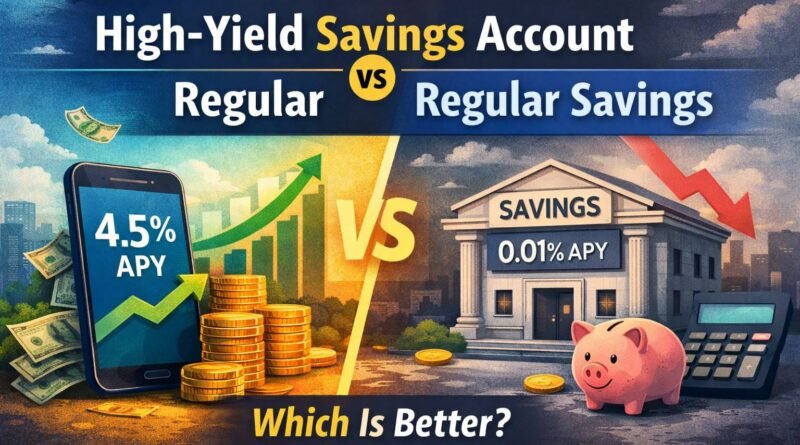
High Yield Savings Account vs Regular Savings – Which Is Better?
Saving money is one of the most basic financial habits — yet many people unknowingly lose money every year simply by keeping their savings in the wrong place.
If your savings account is earning 0.01% interest, your money is not growing. In reality, it’s slowly shrinking due to inflation. This is why the debate between high-yield savings accounts vs regular savings accounts matters more than ever.
So which one is actually better?
And more importantly, which one should you be using right now?
This guide breaks it all down in simple terms, so you can make a smart, low-risk decision with your money.
Understanding Regular Savings Accounts
A regular savings account is the traditional savings option offered by most brick-and-mortar banks. These accounts have been around for decades and are often opened alongside a checking account.
Key Features of Regular Savings Accounts
- Extremely low interest rates (usually 0.01%–0.05% APY)
- FDIC insurance up to $250,000 per depositor
- Easy access through physical branches
- Often linked directly to your checking account
- May require a minimum balance
- May charge monthly maintenance fees
The Hidden Problem With Regular Savings
The biggest issue is not safety — it’s growth.
At 0.01% APY:
- $5,000 earns about $0.50 per year
- $10,000 earns about $1 per year
Meanwhile, inflation typically averages 3% or more, meaning your purchasing power declines even though your balance technically stays the same.
What Is a High-Yield Savings Account?
A high-yield savings account (HYSA) is a savings account that pays a much higher interest rate, usually offered by online banks and financial technology companies.
Because these banks don’t maintain physical branches, they save money on overhead and pass those savings on to customers in the form of higher interest rates.
Key Features of High-Yield Savings Accounts
- Significantly higher interest rates (often 4%–5%+ APY)
- FDIC or NCUA insurance (same protection as traditional banks)
- No physical branches (online and mobile access)
- Low or zero fees
- No or low minimum balance requirements
Why They Exist
High-yield savings accounts were designed to:
- Help savers earn meaningful interest
- Compete with traditional banks
- Encourage smarter cash management
High-Yield Savings vs Regular Savings: A Direct Comparison
| Feature | High-Yield Savings Account | Regular Savings Account |
|---|---|---|
| Interest Rate | 4%–5%+ APY | 0.01%–0.05% APY |
| FDIC Insurance | Yes | Yes |
| Fees | Usually none | Often monthly fees |
| Minimum Balance | Usually none | Often required |
| Access | Online & mobile | Branch + online |
| Best Use | Emergency fund, short-term savings | Temporary holding only |
How Much More Can You Actually Earn?
Let’s look at a realistic example.
Example: $15,000 in Savings for One Year
- Regular savings (0.01%) → $1.50 interest
- High-yield savings (4.5%) → $675 interest
That’s a $673.50 difference — without any investment risk.
Over multiple years, the gap becomes massive.
Why High-Yield Savings Accounts Are Better for Most People
1. Your Money Works Instead of Sitting Idle
A high-yield savings account allows your money to earn meaningful interest while remaining fully accessible.
You don’t need to lock funds away or take market risk.
2. Same Safety, Better Returns
Many people assume higher interest equals higher risk — but that’s not true here.
Both regular and high-yield savings accounts are:
- FDIC-insured (or NCUA-insured)
- Backed by US government protections
- Equally safe up to $250,000
The only real difference is how much interest you earn.
3. Lower Fees and Fewer Restrictions
Most high-yield savings accounts offer:
- No monthly maintenance fees
- No minimum balance requirements
- Free transfers to checking accounts
In contrast, traditional banks often rely on fees as a revenue source.
4. Ideal for Emergency Funds
Your emergency fund should be:
- Safe
- Liquid
- Earning interest
High-yield savings accounts check all three boxes, making them the best place for emergency savings.
When a Regular Savings Account Might Still Make Sense
Although high-yield savings accounts are better for most people, regular savings accounts can still have limited use cases.
You might prefer a regular savings account if:
- You need in-person banking access
- You deposit cash frequently
- Your bank offers relationship perks
- You’re holding money very short-term (days, not months)
Even in these cases, many people keep only a small balance in regular savings and store the rest in a high-yield account.
Are High-Yield Savings Accounts Safe?
Yes — when opened with an insured institution.
What to Check Before Opening One
- FDIC or NCUA insurance
- Competitive and transparent APY
- No withdrawal penalties
- Easy-to-use mobile app
- Strong customer support
💡 Important: Interest rates can change over time, so choose banks known for staying competitive rather than offering short-term teaser rates.
High-Yield Savings vs Investing: A Common Confusion
Many beginners ask:
“If high-yield savings earn 4–5%, why invest at all?”
The answer lies in risk and time horizon.
High-Yield Savings Accounts Are Best For:
- Emergency funds
- Short-term goals (1–3 years)
- Down payments
- Vacation savings
- Peace of mind
Investing Is Best For:
- Long-term wealth building
- Retirement
- Beating inflation over decades
Smart Strategy
Use both:
- Savings for safety
- Investments for growth
Common Mistakes People Make With Savings Accounts
- Leaving large sums in low-interest accounts.
- Confusing savings with investing.
- Ignoring inflation.
- Chasing high rates without checking fees.
- Keeping emergency funds in risky assets.
Avoiding these mistakes alone can dramatically improve your financial stability.
How Much Money Should You Keep in a High-Yield Savings Account?
A general guideline:
- 3–6 months of living expenses for emergencies.
- Additional short-term savings for planned expenses.
Anything beyond that may be better invested for long-term growth.
How to Switch to a High-Yield Savings Account
Switching is simple and usually takes less than 15 minutes.
Basic Steps
- Choose an FDIC-insured online bank.
- Open an account online.
- Link your checking account.
- Transfer funds.
- Monitor interest earnings.
You can keep your regular savings account open if you want — many people do.
Final Verdict: Which Is Better?
✅ High-yield savings accounts are better for most people.
They offer:
- Significantly higher interest.
- The same level of safety.
- Fewer fees.
- Better protection against inflation.
If your money is sitting in a regular savings account earning close to nothing, switching to a high-yield savings account is one of the simplest and smartest financial moves you can make.
Key Takeaway
You work hard for your money.
Where you store it matters.
A high-yield savings account won’t make you rich overnight — but it will stop you from losing money quietly to inflation and low interest rates.
That alone makes it worth it.
Disclaimer:
This article is for educational purposes only and is not personalized financial advice. Everyone’s situation is different, so always do your own research and consult a qualified financial professional before making any banking or investment decisions. Some links in this post may be affiliate links, which means we may earn a small commission at no extra cost to you if you sign up through them.

Madison Kate is a content writer and digital journalist based in the United States, specializing in global politics, technology, finance, and trending world news. She is the lead writer at The World Point, where she has published extensively on international affairs, emerging technologies, economic trends, and current events.