Trump’s February 28 Address on Iran: War Declared, Bombs Fall on Tehran
A Historic and Sobering Moment in U.S. History
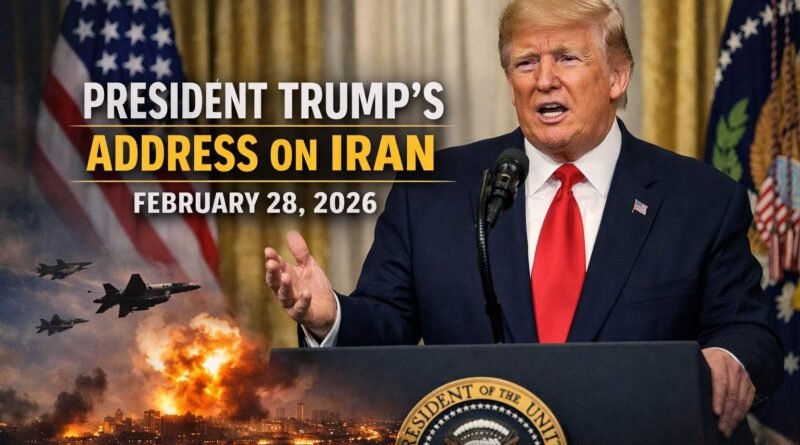
In the early hours of Saturday, February 28, 2026, President Donald Trump delivered one of the most consequential addresses in modern American history — announcing that the United States military had launched major combat operations against Iran. The declaration, posted on Truth Social and broadcast nationwide, marked a dramatic and sudden escalation of a months-long diplomatic standoff over Iran’s nuclear ambitions. Within hours, explosions were reported in Tehran, airspace over Iran was closed, and the Middle East was thrust into a new era of open conflict.
This blog post breaks down everything you need to know about Trump’s February 28 address on Iran: what he said, the events that led to this moment, the international reaction, and what may come next.
The Address: What Trump Said on February 28, 2026
In his war declaration statement, President Trump announced that U.S. military forces had begun what he described as “major combat operations” inside Iran. The stated objective, according to the address, was to defend the American people by eliminating what the administration characterized as imminent threats from the Iranian regime.
Trump’s speech laid out a sweeping historical indictment of the Islamic Republic, stretching back 47 years to the 1979 revolution and the hostage crisis that followed. He cited the 1983 Marine barracks bombing in Beirut, which killed 241 American military personnel, the 2000 attack on the USS Cole, Iranian support for proxy forces in Iraq, and decades of what he called a campaign of bloodshed targeting American troops and allies.
Central to his justification was the nuclear issue. Trump referenced “Operation Midnight Hammer,” the joint U.S.-Israeli strikes conducted the previous June that targeted Iran’s nuclear facilities at Fordow, Natanz, and Isfahan. He claimed those operations had obliterated Iran’s nuclear weapons program, but argued that Tehran had defied post-strike warnings by attempting to rebuild its capabilities.
“They can never have a nuclear weapon,” Trump said emphatically, echoing language he had repeated throughout his second term. “We wiped it out and they want to start all over again.”
Perhaps the most striking element of the address was Trump’s direct message to the Iranian people — urging civilians to stay indoors, warning that “bombs will be dropping everywhere,” and calling on the Iranian Revolutionary Guard Corps (IRGC) to lay down their arms. He also reportedly called on Iranians to rise up against their government, framing the strikes as a form of humanitarian intervention.
The Road to War: Months of Escalating Tensions
To understand February 28, it is essential to trace the road that led there. The trajectory from diplomacy to open warfare unfolded over several critical months.
June 2025: Operation Midnight Hammer
The first major inflection point came in June 2025, when the United States and Israel carried out coordinated airstrikes on Iran’s key nuclear infrastructure. The strikes targeted the enrichment sites at Fordow, Natanz, and Isfahan — facilities long considered the backbone of Iran’s nuclear program. The Biden-to-Trump transition had already raised regional tensions, and these strikes marked the opening act of a new confrontational posture toward Tehran.
The State of the Union: February 24, 2026
Just days before the war declaration, Trump delivered his 2026 State of the Union address — the longest in presidential history at one hour and 48 minutes. During that address, he laid out his case against Iran for a national audience, striking what analysts described as a deliberately belligerent tone. He claimed Iran was actively attempting to rebuild its nuclear weapons program, warned of Iranian ballistic missiles being developed that could eventually reach American soil, and cited the brutal crackdown on protesters in January 2026, which he claimed had killed tens of thousands of Iranian civilians.
Significantly, Trump also expressed a preference for diplomacy — stating that he wanted to solve the crisis through negotiations, but made clear he would never permit Iran to acquire a nuclear weapon. That speech, experts noted at the time, appeared designed to prepare American public opinion for a possible military campaign while leaving a window open for a last-minute deal.
The Failed Geneva Talks
Following the State of the Union, both sides returned to the negotiating table. U.S. envoys, including Jared Kushner and Steve Witkoff, met with Iranian Foreign Minister Abbas Araghchi in Geneva for indirect talks mediated by Oman. The negotiations, however, produced no breakthrough. Iran maintained its position that it had the right to enrich uranium for peaceful purposes and demanded substantial sanction relief in return for any nuclear concessions. The U.S., for its part, appeared to want a far more sweeping agreement — possibly requiring Iran to abandon all domestic enrichment entirely.
On February 27, Trump told reporters he was “not happy” with the direction of the talks. Oman’s Foreign Minister Badr al-Busaidi, who had been mediating the discussions, appeared to publicly plead for more time, stating on CBS News that he felt a deal was “within reach.” He noted that Iran had expressed willingness to surrender its enriched uranium stockpile and halt further accumulation, calling these significant breakthroughs. But it was not enough.
The Final Hours Before the Strike
In the hours just before Trump made his announcement, Iran’s Foreign Minister Araghchi issued a social media post declaring that Iran had a “historic opportunity” to reach an “unprecedented agreement.” He insisted that Iran would “under no circumstances ever develop a nuclear weapon,” while reiterating the country’s right to peaceful nuclear technology. It was a last-ditch diplomatic gesture — one that was ultimately overtaken by events.
The Strikes: What Happened on February 28?
In the early hours of Saturday morning, the United States and Israel launched coordinated military strikes against targets inside Iran. Explosions were reported in Tehran, with smoke rising over the capital. Iran’s airspace was closed, with reports indicating the restriction would remain in effect for at least six hours.
Israel officially confirmed its participation in the operation, with Israeli Defense Minister Israel Katz stating that the strikes were intended to “remove threats.” The Israeli Defense Forces described the operation — reportedly called “Operation Judas Shield” — as a preemptive strike that had been in preparation for months.
Iran’s Supreme Leader Ayatollah Ali Khamenei was reportedly transferred to a secure, undisclosed location following the outbreak of hostilities. Meanwhile, the IDF issued a national warning to Israeli citizens, alerting them of the possibility of incoming Iranian missiles. Indeed, Iran launched a barrage of retaliatory missiles toward Israel, triggering widespread air raid sirens and activating the country’s defense systems across the country.
The scale and coordination of the strikes represented the largest U.S. military operation in the Middle East since the 2003 invasion of Iraq — and potentially the most significant direct confrontation with Iran since the Islamic Republic’s founding.
International Reactions
Iran
Tehran’s response was defiant and immediate. Even before the formal declaration of war, Iran’s Foreign Ministry had been accusing the Trump administration of repeating “big lies” about its nuclear program and the scope of its domestic crackdowns. Iranian officials insisted they were not seeking nuclear weapons and warned that U.S. military action would be met with retaliation against American bases throughout the region.
Foreign Minister Araghchi had previously stated that while Iranian missiles could not reach American soil, U.S. military installations in the broader Middle East would be legitimate targets in any retaliatory campaign — a warning that took on immediate urgency as the strikes began.
Oman and Regional Mediators
Oman, which had been serving as the key diplomatic intermediary between Washington and Tehran, found its mediation role suddenly obsolete. The Omani foreign minister had met with U.S. Vice President JD Vance just hours before the strikes and expressed optimism about the pace of negotiations. His public appeal for continued diplomacy went unheeded.
The U.S. Congress
Prior to the strikes, concerns had already been raised on Capitol Hill. Representative Jim Himes of Connecticut, the ranking member on the House Intelligence Committee, had expressed alarm following a classified briefing from Secretary of State Marco Rubio and CIA Director John Ratcliffe. He stated publicly that he had not heard a compelling rationale for why military action was necessary at that specific moment — a sentiment that is likely to fuel significant congressional debate in the days ahead.
Expert Analysis
Think tank analysts and foreign policy experts had been warning for weeks that the two sides remained far apart in their negotiating positions. Sanam Vakil, director of the Middle East and North Africa Program at the Chatham House think tank in London, noted that despite some rhetorical gestures from both sides, the core disagreements over enrichment had not been resolved.
The Nuclear Question: What Was at Stake
At the heart of Trump’s address and the broader conflict is the question of Iran’s nuclear program. The United States has insisted that Iran must never acquire a nuclear weapon — a position with broad bipartisan support. The Trump administration went further, reportedly seeking a deal that would require Iran to abandon all domestic uranium enrichment, a demand Tehran has consistently rejected as a violation of its national sovereignty.
Iran, for its part, has maintained that its nuclear activities are entirely civilian in nature, in compliance with the Nuclear Non-Proliferation Treaty, and that it has a legal right under international law to enrich uranium for peaceful purposes such as energy and medicine. Iranian officials repeatedly and publicly denied any intention to develop nuclear weapons.
The critical disputed question — one that became the casus belli for the strikes — was whether Iran had begun to rebuild the nuclear infrastructure destroyed in June 2025. Satellite imagery from late January 2026 had shown construction activity at the Natanz and Isfahan sites, with roofs being built over previously damaged structures. The Trump administration interpreted this as evidence of a reconstituted weapons program. Iran and the IAEA offered more ambiguous assessments.
What Comes Next: Scenarios and Implications
The events of February 28, 2026 have opened a period of profound uncertainty for the Middle East and global geopolitics. Several key questions now dominate the strategic landscape:
Will Iran launch a large-scale retaliation? Iran’s early missile launches toward Israel suggest a willingness to respond militarily. The scope and duration of any Iranian counteroffensive will shape whether this conflict remains a targeted campaign or expands into a prolonged regional war.
How will Iran’s proxy network respond? Iran’s affiliated forces in Lebanon, Yemen, Iraq, and Syria have historically acted as force multipliers in times of conflict. Whether Hezbollah, the Houthis, and other groups enter the fight actively will determine the broader regional footprint of this war.
What is the endgame? Trump’s address referenced “regime change” in all but name — calling on the IRGC to lay down arms and on Iranians to overthrow their government. Whether the administration has a clear post-conflict political strategy remains an open and urgent question.
What will be the economic and energy market impact? Iran sits at the edge of the Strait of Hormuz, through which roughly 20% of the world’s oil supply passes. Any disruption to shipping through that chokepoint would have immediate and severe consequences for global energy prices and economic stability.
How will U.S. allies and adversaries respond? Russia and China are likely to condemn the strikes and may seek to exploit the situation diplomatically or materially. European allies, many of whom had been engaged in parallel diplomatic efforts with Iran, face difficult choices about their own positions.
Conclusion: A Defining Moment in the Trump Presidency
Trump’s February 28 address on Iran will be remembered as one of the defining moments of his presidency — and potentially one of the most consequential foreign policy decisions in modern American history. Whether it represents a decisive blow against a destabilizing regime or the opening of a costly and unpredictable war in the world’s most volatile region depends heavily on what unfolds in the coming days and weeks.
What is clear is that months of diplomatic maneuvering, military posturing, and high-stakes negotiations have given way to open conflict. The bombs, as Trump himself warned, are falling. The world is watching.

Madison Kate is a content writer and digital journalist based in the United States, specializing in global politics, technology, finance, and trending world news. She is the lead writer at The World Point, where she has published extensively on international affairs, emerging technologies, economic trends, and current events.