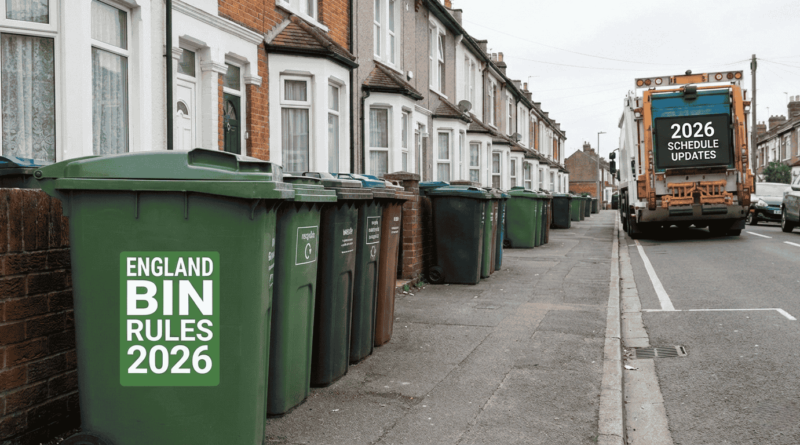
England Bin Collection Rules 2026 — The Complete Guide
England bin collection rules 2026 is among the real changes in the household waste and recycling of the UK in decades. Recycling had not been rising in England due to the stubbornly low recycling rates, and the confusion experienced by councils in an effort to deliver unequal bin collection services, the UK Government has came up with a standardised strategy – known as Simpler Recycling – which aims at simplifying the bin collection process, increasing recycling and aligning local authorities to national targets on waste reduction.
These reforms belong to broader UK new laws 2026 that will cover various industries, yet one of the most apparent to the day-to-day lives will be residential waste collection and bin day collections.
Table of Contents
- What Are the England Bin Collection Rules 2026? — Key Changes Explained
- Detailed Breakdown of Waste Categories
- Bin Day: Schedules, Frequency & Local Variances
- UK New Laws 2026: How the Regulations Changed Waste Collections
- Bin Collection Rules for Flats and Multi-Occupancy Properties
- Penalties, Enforcement & Compliance Risks
- Practical Tips for Residents to Prepare for the New System
- Benefits of the New England Bin Collection Rules 2026
- Common Challenges and Concerns Raised by Residents
- FAQs
- Conclusion: What You Need to Know for 2026 and Beyond
What Are the England Bin Collection Rules 2026? Key Changes Explained
Legal Framework and Policy Background
The UK Government has developed Simpler Recycling policy, and this policy is published by the Department of Environment, Food and Rural Affairs (Defra), hence the new waste collection standards. The rules will come into effect in stages, the significant changes will be in effect since 31 March 2026. The councils will be obligated to collect a standardized set of goods of households throughout England on regular streams, as opposed to the prior different councils having quite different arrangements of bins.
The general idea: abolish the postcode lottery, in which people living in one town had one set of rules on recycling whereas those in the next town had a different set of rules, and make bin collection everywhere in England predictable, easy, and alike.
Simpler Recycling Policy: What It Means to You?
Most households, according to the new England bin collection rules 2026, will experience a difference in the amount of bins they will be required to handle, frequency of their emptying, and contents of their bins.
Some of the key policy principles are:
- Individual collection of type of core waste (food, paper, other recyclables, residual waste).
- Common practices in every local authority in England.
- Baseline service of collecting food waste per week.
- Temporary deals on those councils which have logistical problems.
Four Waste Streams Every Household Must Separate
A policy of Simpler Recycling includes four primary waste streams that should be recovered separately by 31 March 2026 by the councils:
- Food Waste (better to have it weekly, wherever possible)
- Paper and Card
- All Other Recyclable Materials Dry (plastic, metal, glass, and so on).
- Waste that cannot be recycled (Remnant of waste).
These streams are substituting most of the older and haphazard bin systems, which existed in the past.
Detailed Breakdown of Waste Categories
In order to obey the new England bin collection rules 2026, the residents should learn what to place where.
Food Waste Collection
As of 31 March 2026, the local authorities will need to organize food waste collection (weekly) on most homes. Food waste comprises of kitchen refuse, plate leftovers, and other organic contents. The purpose of this will often be to have a small indoor caddy and a larger outdoor bin provided by councils.
This frequency bin day pick-up aims at minimising odours and valuable organic resources to compost or undergo anaerobic digestion – to turn waste into biogas and compost rich in nutrients.
Paper and Card Recycling
Paper and cardboard – such as cereal boxes, newspapers, and paper used in the office should be separated. Although the councils can offer specific bins or boxes that are dedicated to paper and card, it is sometimes also combined with other types of dry recyclables, or it varies under local arrangements.
Dry Recyclables: Plastic, Metal & Glass
The remaining recyclables can be classified as this general category of plastics (bottles, pots, tubs), metals (cans, tins) and glass containers. The policy will provide major advancement in the recycling rates of such materials and make them consistent across all the councils.
There are also councils that are already broadening what it is able to collect; in fact, many of them will be able to receive flexible plastic and bags by March 2027.
Residual Waste (Non-Recyclable)
The things that cannot be recycled or composted will be in the still bin – the one that most people are used to calling the black bin. This stream is normally less frequently collected than the recyclables or food waste, but this is dependent on the local council.
Bin Day: Schedules, Frequency & Local Variances
How is the England bin collection rules 2026 will change is one of the largest questions that inhabitants will ask about the new rule of bin collection in the city?
Although food waste will be picked up once a week, other streams still have the flexibility that the councils can pick them up as frequently as they wish. Lots of them will continue to operate on weekly or even three-weekly schedules dry recycling and residual collections depending on local capacity and service design.
This implies that what day you actually put the bin out might not be the same as your neighbour in the next street if you are in a different district but the principles of what to place in which bin will remain the same.
UK New Laws 2026: How the Regulations Changed Waste Collections
Statutory Requirements for Councils
Within the new legislation, commonly when mentioned as reforms in the Environment Act 2021, councils are required to:
- Separate waste such as food, paper, dry recyclables and residual waste used in each household.
- Offer weekly food waste pick-ups (except in a transitional arrangement).
- Make sure that there is the collection and recycling of garden waste.
- Cycling: Meet quality and environmental requirements.
The same standards apply to private waste collectors who have to ensure that they meet the same standards in the area of their operations.
Transitional Arrangements & Exceptions
Certain councils can be in transitional arrangements i.e. where they require additional time because of current contracts or special logistic difficulties. But the general imperative of parting the main streams is left.
Plastic films and bags will also be included as the necessary recyclable materials in the future – by 31 March 2027.
Bin Collection Rules for Flats and Multi-Occupancy Properties
Most of the people living in apartments or multi occupancy houses are concerned that the bin collection does not apply to them, when in fact the regulations do. The councils are supposed to make sure that separate waste streams are available in all households, including flats but the execution may take the form of communal bins or tailor-made systems depending on space and infrastructure.
Penalties, Enforcement & Compliance Risks
Fines for Incorrect Bin Use
Although household penalties are different according to the council, local authorities may impose fines on bin misuse including dangerous or unsuitable items on the recycling bin or bins placed earlier than the appropriate time. The penalties of wrongly placed bins or pollutions may vary based on the bylaws in the area.