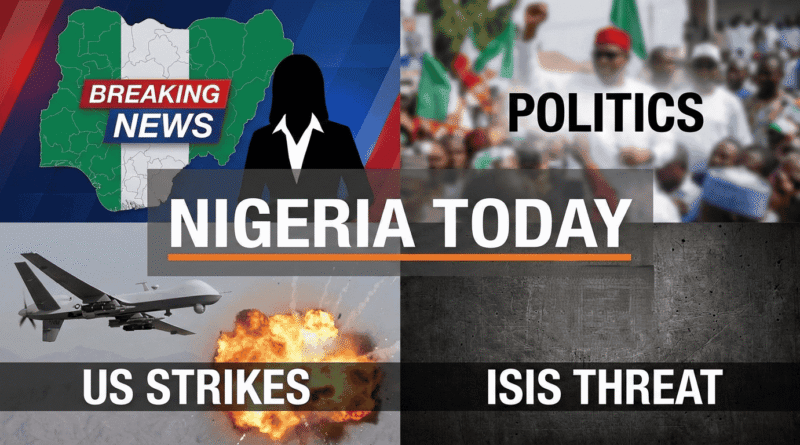
Nigeria Today: Breaking News, US Strikes, ISIS & Politics
Nigeria is the most populous country in Africa and one of the most dynamic economies that is still left in the centre of the world agenda on politics, security, and development. Whether discussing internal power structure and economic restructuring, or reading about military action and terrorist threats, Nigeria is still the centre of media attention and international policy discussions.
By the conclusion of this paper, you will have had the full picture of the affairs, the historical conflicts and the outlook of Nigeria.
Table of Contents
- What Is Nigeria? — Geography, People, and Economy
- Political Landscape of Nigeria
- Nigeria’s Security Challenges
- U.S. Military Strikes in Nigeria — Context and Controversy
- Nigeria’s Foreign Relations — Including U.S.–Nigeria Ties
- Nigeria News Trends in 2025
- Culture, Tourism, and Positive Narratives
- Economic Outlook and Development Initiatives
- Nigeria’s Role on the Global Stage
- Frequently Asked Questions About Nigeria
- Conclusion
What Is Nigeria? Geography, People, and Economy
Nigeria is a nation in West Africa, bordered by Benin, Niger, Chad and Cameroon and the southern side of the country runs along the Gulf of Guinea. It is the most populous African country and accommodates more than 220 million individuals who have different ethnicities, languages, and cultures. The economy of Nigeria is one of the biggest in the continent because of the large reserves of oil, the developing tech industry (including the so-called Nigerian Silicon Valley in Lagos), and a big domestic market.
Nigeria is not as simple as it could be, and the complex challenges of the country include political fragmentation, internal security threats, and economic inequality.
Political Landscape of Nigeria
The All Progressives Congress (APC)
The All Progressives Congress (APC) is a political party that is in power in Nigeria and that it was formed in 2013 as a result of a merger between various opposition groups. Since 2015, it has been ruling Nigeria and remains a dominant force in the domestic political arena affecting key decisions on security, economy and foreign policy, particularly where foreign military collaboration and domestic reform are involved.
The People’s Democratic Party (PDP)
The popular party in Nigeria during the early 2000s and still a powerful opposition party is the People Democratic Party (PDP). It supports democratic reforms and economic policies that are aimed at enhancing stability and growth.
Governance Challenges and Reforms
The governance history of Nigeria has been full of corruption, institutional weaknesses as well as political tensions. Combating systemic corruption and enhancing democratic institutions are still critical towards the long-term course of the country.
Nigeria’s Security Challenges
Boko Haram and ISIS in Nigeria
Insurgent violence has been one of the most persistent problems in Nigeria. Organizations such as Boko Haram and its ISWAP (Islamic State West Africa Province) arm are still perpetrating violence especially on the northeast. Such extremist groups have conducted attacks, kidnappings, and bombings against civilian and security agents, which have led to instability and humanitarian emergencies.
Recent Mosque Bombings and Terrorist Attacks
A suicide bombing in Maiduguri, Borno State on December 25, 2025 in the Al-Adum mosque, killed at least five worshippers and injured about 35 more as they were taking evening prayers. This assault highlighted the continued reality of extremist violence and the continued adoption of bombings as a terror tactic by Nigeria.
Local Insurgencies and Banditry
Other than Boko Haram and ISIS, other armed groups involved in bandits and territorial wars have affected the rural communities. As a case in point, the Nigerian insecurity situation is wide-ranging, as evidenced by the 2025 Kwallajiya attack in Sokoto State, in which ISIS Sahel Province militants unleashed a killing raid on farmworkers and villagers.
U.S. Military Strikes in Nigeria — Context and Controversy
Why the U.S. Struck ISIS in Nigeria?
Later in December 2025, the United States used air strikes to attack ISIS targets in northwest Nigeria. The strikes were declared by former U.S. President Donald Trump as a reaction to continuous violence of Islamic militants, in particular, attacks against predominantly Christian populations, which is a significant and debatable point within the narrative.
Coordination with Nigerian Authorities
As opposed to stories that posted the operation as unilateral, Nigeria affirmed that these attacks were collaborative coordinated security arrangements with the United States. Nigerian officials had been able to conduct intelligence dissemination and strategic coordination with the U.S. troops to conduct precision attacks against extremist targets. The cooperation between the two countries, that is, bilateral coordination and not an imposed action, was pre-empted by the Nigerians when they were able to provide the key intelligence before the strikes.
Did the U.S. Bomb Nigeria? Key Facts
Questions of whether the U.S bombed Nigeria has been the subject of many news outlets and discussions. The thing is that U.S. attacks were delivered against ISIS and radical camps, and the Nigerian government officially recognized the alliance. These were military actions which are controversial but implemented under the models of security collaboration and mutual demand rather than an invasion and unilateral attack.
Reactions and Global Implications
The American strikes have been met with mixed reaction. Although the Nigeria strike operations are applauded as essential in curbing the acts of terrorism by some commentators, others feel that the operations will jeopardize sovereignty and the local political stability. The example of Islamic scholar Dr. Ahmad Gumi, who demanded that military aid be discontinued and Nigeria be left to defend itself against bombardments by foreign countries.
Nigeria’s Foreign Relations — Including U.S –Nigeria Ties
Nigeria practice complex foreign relations balancing the international relations and regulating its sovereignty. The U.S.-Nigeria relations involve diplomatic relations, security relations, and economic relations although the tensions surrounding military operations and religious freedom discourse sometimes come up.
By the end of 2025, the debate on the U.S. role in Nigeria has centered on the ways in which both the states can coordinate their counter-terrorism operations without compromising the autonomy and domestic policies of Nigeria.
Nigeria News Trends in 2025
The news that dominated Nigeria news in 2025 was:
- Security and terrorism news– deadly attacks and military response.
- Military inter-cooperation on the international level, particularly American air attacks against extremist groups in northwest Nigeria.
- Political forces – discussion of reforms in the governance and party politics.
- Policy changes on the economic fronts, e.g., new tourism structures, to spread growth.
- Cultural coverage – Nigeria is an interesting country culturally with its rich arts, music and festivals attracting attention of the global community.
All these issues have influenced international and regional discourses regarding Nigeria in the course of the year.
Culture, Tourism, and Positive Narratives
Nigeria is diverse in terms of culture, despite the news of insecurity. The most memorable one is the Calabar Carnival, which is considered the biggest street party in Africa and takes place every year in Cross River State and brings international tourists.
Also, in December 2025 Nigeria had passed a National Tourism Framework to drive economic diversification with tourism, creation of jobs and global branding. This brings out attempts to change the discourse to stability, culture, and economic prospect.
Economic Outlook and Development Initiatives
The economy of Nigeria is one of the largest African economies based on oil exports but becoming more and more diversified with technology, services and agriculture. The most recent collaboration with the World Bank is intended to enhance the creation of jobs, economic stability, and the capacity of the public sector, and this is a promising direction of sustainable development.
New industries that include fintech and creative industries (music, film, fashion) are persistently attracting interest and investment in Nigeria.
Nigeria’s Role on the Global Stage
Nigeria is the most populous country in Africa, and therefore it has a central role in continental politics, economic systems such as the ECOWAS (Economic Community of West African States), and conflict resolution measures. The security collaboration between Nigeria and its allies such as the United States also makes it an important collaborator in the fight against terrorism and to ensure stability in the region.
Frequently Asked Questions About Nigeria
1. Did the U.S. really carry out airstrikes in Nigeria, and why?
Yes– in December 2025, airstrikes against ISIS-linked extremist groups were launched by the United States against them in northwest Nigeria. The U.S. leadership publicly announced the strikes and targeted the destruction of terrorist cells that have been blamed to cause constant attacks on civilians. Nigeria has asserted that it was carried out in close security cooperation with the U.S. government combating the terrorism threats and not as an invasion and unilateral move.
2. What extremist groups are active in Nigeria, such as ISIS and Boko Haram?
Nigeria has been experiencing historical insurgencies by factions such as Boko Haram and its branch off ISWAP (Islamic State West Africa Province) both affiliated to ISIS in Nigeria. Newer cells such as Lakurawa have been reported to have been used in the northwest. Such organizations include bombings, kidnappings and armed attacks to destabilize communities particularly in the north.
3. Is terrorism the main reason the U.S. engaged militarily in Nigeria?
Yes — the U.S. military action has been rallied under the pretext of counter-terrorism, namely against the ISIS-linked militants. The U.S. leadership statements are taking note of the extremist violence as a reason on why the strikes should be carried out- despite the fact that the violence is hurting more than one communities and is rooted in dynamics of the war.
4. What is the Nigeria general strike about and how has it impacted the country?
Another event was a large-scale general strike of labor unions in Nigeria in 2024, which demanded a large wage increase as a result of a cost-of-living crisis. The strike took a number of weeks before another minimum wage agreement was reached. The incidence is one of the major landmarks that are still used in the context of economic strain, employee rights and inflation within the country.
5. What are the current travel advisories or safety concerns for visiting Nigeria?
The travel warnings issued by the officials advise tourists to re-evaluate their plans to travel to Nigeria as there is risk of crime, terrorism, kidnapping, and civil unrest. Some states are identified as more dangerous than the rest particularly in the North East and Northwest states because of the insurgent activities and banditry and, as such, security is one of the major concerns of a traveler or an expatriate.
Conclusion
The history of Nigeria is not simple, multi-lateral and everlasting. Based on the headlines of the Nigeria attack to more serious discussions regarding governance, cultural identity, economic potential and international partnerships, the country is at a very critical crossroads. On one hand, there are the issues of security such as ISIS in Nigeria and the bombing, but on the other hand, it is possible to highlight positive steps of such processes as tourism promotion, economic reforms and international collaboration towards the more stable and wealthy future.
With a wider perspective, namely, US attacks on Nigeria, the politics of Trump Nigeria, and Nigeria as an actor in international politics, the readers can take the full picture of a country that has to have its own way in the 21st century in the world, but still needs to stay resilient and ambitious.