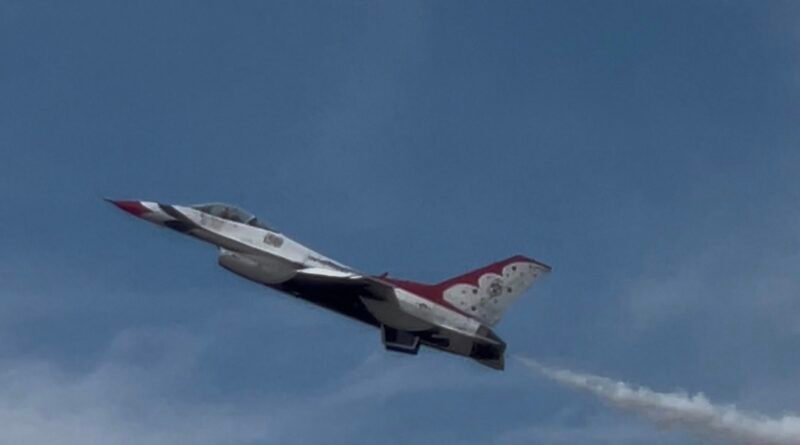
The F-22 Raptor: Built Not to Compete, But to Dominate the Skies
Introduction: A Fighter Jet Unlike Any Other
When the United States Air Force introduced the F-22 Raptor, it did not just add another aircraft to its fleet — it redefined what air superiority truly means. Developed by Lockheed Martin and Boeing, the F-22 Raptor is widely regarded as the most capable and technologically advanced fighter aircraft ever built. It is not simply a jet that flies faster or shoots farther than its competitors. It is an entirely new generation of airpower — one that blends stealth, speed, agility, and electronic warfare into a single, breathtaking machine.
Since its official introduction into service in 2005, the F-22 Raptor has remained in a class of its own. No adversary nation has been able to field a fighter that matches its combination of capabilities. Whether you are a military aviation enthusiast, a curious reader, or someone who simply saw a video of the Raptor pulling off an impossible maneuver at an air show, this blog post will walk you through everything — from its origin story and technical specifications to its hidden features and strategic importance in modern warfare.
Buckle up. This is the full story of the most dominant fighter jet ever to take flight.
The Origin Story: Why Was the F-22 Built?
The Cold War Threat That Sparked a Revolution
To understand the F-22, you need to travel back to the early 1980s. The Cold War was at its peak, and the United States Air Force was growing increasingly concerned about the Soviet Union’s next generation of fighter aircraft. Soviet jets like the Su-27 Flanker and the MiG-29 Fulcrum were being developed with capabilities that could directly challenge American air superiority.
At the time, the U.S. relied heavily on the F-15 Eagle, an exceptional aircraft by any measure. But military planners knew that by the time the Soviet jets reached full production, the F-15 might no longer hold an undisputed advantage. The Air Force needed something entirely new — a fighter designed not just to match the enemy but to outclass them so thoroughly that aerial combat would be decided before the enemy even knew what hit them.
The Advanced Tactical Fighter Program
In 1981, the U.S. Air Force launched the Advanced Tactical Fighter (ATF) program. The goal was ambitious: design a next-generation air superiority fighter that would incorporate stealth technology, supercruise capability, advanced avionics, and superior maneuverability — all in one aircraft. Two competing design teams were selected: Lockheed/Boeing/General Dynamics and Northrop/McDonnell Douglas.
After years of development and competitive evaluation, the Lockheed-led design won the contract in 1991. The aircraft would eventually be named the F-22 Raptor. Development continued through the 1990s, and after extensive testing, the F-22 achieved Initial Operational Capability in December 2005.
The end of the Cold War shifted the geopolitical landscape, but the need for air dominance never disappeared. The Raptor was built for a world where the skies are contested — and it remains ready for exactly that.
Technical Specifications: The Numbers Behind the Legend
Before diving into the Raptor’s unique features, it helps to understand just how extraordinary its basic performance figures are.
| Specification | Detail |
|---|---|
| Primary Role | Air Superiority Fighter |
| Manufacturer | Lockheed Martin / Boeing |
| Crew | 1 Pilot |
| Length | 62 ft (18.9 m) |
| Wingspan | 44.5 ft (13.6 m) |
| Height | 16.7 ft (5.1 m) |
| Maximum Speed | Mach 2.25+ (approx. 1,500 mph) |
| Supercruise Speed | Mach 1.82 (without afterburner) |
| Service Ceiling | 65,000 ft (19,812 m) |
| Combat Radius | 590 miles (950 km) |
| Engines | 2 × Pratt & Whitney F119-PW-100 |
| Thrust per Engine | 35,000 lbf with afterburner |
| Total Aircraft Built | 187 operational aircraft |
These figures alone are impressive. But raw numbers only tell part of the story. What makes the F-22 truly remarkable is how all of these capabilities work together as a unified system.
Stealth Technology: The Art of Invisibility
What Makes the F-22 Stealthy?
Stealth is perhaps the most talked-about feature of the F-22, and for good reason. The Raptor is designed to have an extremely low radar cross-section (RCS) — meaning it reflects very little radar energy back to enemy sensors. In practical terms, the F-22 can appear as small as a metal marble on enemy radar screens, despite being a full-size fighter jet.
This near-invisibility is achieved through a combination of factors. The aircraft’s shape is carefully engineered so that radar waves are deflected away from their source rather than bounced back. Every surface, angle, and edge of the airframe is designed with radar absorption in mind. The aircraft uses radar-absorbing materials (RAM) on its skin, which absorb radar waves instead of reflecting them. Even the cockpit canopy is coated with a special material to prevent radar from bouncing off the pilot’s helmet.
Internal Weapons Bays: The Hidden Arsenal
One of the most strategically important stealth features of the F-22 is its use of internal weapons bays. Conventional fighter jets carry missiles and bombs on external pylons beneath the wings and fuselage. While this allows for a larger payload, it dramatically increases the aircraft’s radar signature. Every pylon, every missile, every fuel tank hanging off the wings creates a radar reflection.
The F-22 solves this problem by storing all of its weapons inside the aircraft. Three internal bays house the Raptor’s arsenal, which includes AIM-120 AMRAAM medium-range missiles, AIM-9 Sidewinder short-range missiles, and if needed, 1,000-pound Joint Direct Attack Munitions (JDAMs) for ground targets. The weapons bay doors only open briefly when a missile is fired, keeping the radar signature minimal throughout the mission.
Low Observable Design in Every Detail
Stealth on the F-22 is not just about the big picture — it extends to the smallest details. The screws and fasteners on the aircraft’s skin are flush with the surface to eliminate radar reflection points. Exhaust nozzles are specially designed to reduce the aircraft’s infrared signature, making it harder for heat-seeking missiles to track. Even the paint scheme of the aircraft is chosen to reduce visual detectability at high altitudes.
Supercruise: Speed Without Burning Everything
One of the most underappreciated capabilities of the F-22 is its supercruise ability — the ability to fly at supersonic speeds without using its fuel-hungry afterburners.
Most fighter jets can only achieve supersonic flight by engaging afterburners, which dump raw fuel into the exhaust stream and ignite it for a massive but temporary thrust boost. The problem is that afterburners consume fuel at a staggering rate and cannot be sustained for long periods.
The F-22’s Pratt & Whitney F119 engines are powerful enough to push the aircraft past the speed of sound in “dry” thrust — that is, without afterburners. The Raptor can cruise at approximately Mach 1.82, roughly 1,220 miles per hour, without afterburner use. This allows the aircraft to cover large distances quickly, engage threats and reposition faster than any adversary, and spend less time in dangerous airspace.
In practical combat terms, supercruise gives the F-22 a significant tactical advantage. It can enter a threat area at supersonic speed, engage enemies at long range, and exit before adversaries can respond — all while conserving fuel for a return trip or extended patrol.
Maneuverability: Defying the Laws of Physics
Thrust Vectoring: Pointing the Nose Anywhere
Speed and stealth would mean little if the F-22 could not maneuver. This is where the Raptor becomes even more astonishing. The aircraft is equipped with thrust-vectoring nozzles on its engines, meaning the exhaust can be directed up or down to give the aircraft additional pitch control.
Thrust vectoring allows the F-22 to perform maneuvers that are physically impossible for conventional aircraft. The jet can point its nose in virtually any direction while the aircraft’s body continues moving on its original flight path — a capability known as high angle of attack (AoA) flight. At air shows, the Raptor has demonstrated the ability to point its nose nearly straight up while traveling slowly, then recover smoothly — a maneuver that would send any other aircraft into an uncontrollable spin.
The Herbst Maneuver and Beyond
The F-22 can execute the famous Herbst maneuver (also called the J-turn), in which the aircraft essentially flips direction at low speed, reversing its heading almost instantly. In a close-range dogfight, this ability to rapidly change direction and point the nose at an enemy can be the difference between life and death.
Combined with its fly-by-wire flight control system — which uses computers to translate the pilot’s inputs into precise control surface movements — the F-22 is extraordinarily stable and responsive even at extreme angles of attack where most aircraft would stall and fall out of the sky.
Avionics and Sensors: The Brain of the Raptor
The AN/APG-77 AESA Radar
The F-22’s primary sensor is the AN/APG-77 Active Electronically Scanned Array (AESA) radar, one of the most advanced airborne radar systems in existence. Unlike traditional mechanically scanned radars, which move a single antenna to scan the sky, AESA radars use thousands of tiny transmitter/receiver modules that can steer the radar beam electronically — almost instantaneously.
This gives the AN/APG-77 several major advantages. It can detect stealth aircraft that conventional radars cannot. It can track multiple targets simultaneously while also providing detailed electronic warfare capabilities. And because the radar beam can be shaped and directed so precisely, it is extremely difficult for enemy electronic warfare systems to detect that the Raptor is even using its radar.
Sensor Fusion: Seeing the Whole Battlefield
One of the most sophisticated aspects of the F-22’s avionics is its sensor fusion system. The aircraft collects data from its radar, electronic warfare sensors, infrared detectors, and communication systems and combines all of this information into a single, clear picture displayed in the cockpit.
The pilot does not have to mentally piece together information from multiple displays. Instead, the aircraft’s computers process everything and present a unified, intuitive tactical picture. The pilot knows where every friendly and enemy aircraft is, what threats are active, and what the best course of action is — all at a glance.
The Helmet-Mounted System and Cockpit
The F-22’s cockpit is dominated by large multifunction displays that replace most of the traditional dials and gauges found in older fighters. The pilot controls the aircraft through a combination of HOTAS (Hands On Throttle And Stick) controls, allowing hands to stay on the primary flight controls while managing weapons and sensors.
Electronic Warfare: Winning Without Firing a Shot
The F-22 is not just a weapons platform — it is also a powerful electronic warfare aircraft. Its AN/ALR-94 electronic warfare system is one of the most capable passive sensor suites ever fitted to a fighter jet. The system can detect enemy radar emissions, identify the type of radar, determine the direction and range of the threat, and in some cases jam enemy systems.
Crucially, the ALR-94 can cue the AN/APG-77 radar to look in the precise direction of a threat, allowing the radar to operate in a highly focused, low-probability-of-intercept mode. This means the Raptor can gather information on enemy aircraft without revealing its own presence — a form of electronic stealth that complements its physical stealth design.
In a future conflict involving sophisticated adversaries with advanced air defense systems, the F-22’s electronic warfare capabilities could be just as important as its missiles.
Hidden Features and Lesser-Known Capabilities
Intra-Flight Data Link (IFDL)
The F-22 uses a proprietary Intra-Flight Data Link that allows Raptors to share targeting and sensor data with each other without using radio transmissions that could be detected or jammed. A group of F-22s can operate as a coordinated network, sharing a common tactical picture while maintaining near-complete radio silence. This “silent coordination” is a significant tactical advantage against adversaries who rely on electronic intelligence to track aircraft communications.
The “Persistent Presence” Tactic
Because of its supercruise capability and high service ceiling, the F-22 can patrol contested airspace at extremely high altitude and speed for extended periods. Operating at 60,000 feet while flying at supersonic speed, the Raptor can monitor an enormous area, respond rapidly to any threat, and remain largely invisible to both radar and visual detection from the ground.
Aerial Refueling
Despite its incredible range and efficiency, the F-22 is equipped with an aerial refueling receptacle, allowing it to be refueled in flight by KC-135 and KC-46 tanker aircraft. This extends its operational range virtually indefinitely and allows for very long-duration missions deep into contested territory.
Dogfight Capability: The Gun
While the F-22 is primarily designed for beyond-visual-range (BVR) combat using its radar and long-range missiles, it is also equipped with an M61A2 Vulcan 20mm rotary cannon for close-range engagements. The gun is mounted internally on the right side of the aircraft and is concealed behind a small door that opens only when the gun is fired, preserving the aircraft’s stealth profile.
The F-22 vs. The World: How It Compares
F-22 vs. F-35 Lightning II
The F-35 is often compared to the F-22, but the two aircraft serve very different roles. The F-35 is a multirole stealth aircraft designed for a wide range of missions including air-to-ground strike, close air support, and reconnaissance, in addition to air-to-air combat. The F-22 is a dedicated air superiority fighter optimized for one thing: destroying enemy aircraft before they can pose a threat.
In a pure air-to-air engagement, the F-22 is considered significantly superior to the F-35. The Raptor is faster, more maneuverable, has a more powerful radar, and carries a heavier air-to-air missile load. The F-35 acknowledges its limitations in this area and is designed to complement the F-22 rather than replace it.
F-22 vs. Su-57 (Russia)
Russia’s Su-57 Felon is often cited as the Raptor’s closest rival. The Su-57 features stealth shaping, supercruise capability, and highly advanced avionics. However, independent analyses consistently suggest that the Su-57’s radar cross-section is significantly larger than the F-22’s, meaning it is considerably easier to detect on radar. Additionally, production of the Su-57 has been very slow, with only a small number of aircraft currently operational.
F-22 vs. J-20 (China)
China’s Chengdu J-20 Mighty Dragon is another fifth-generation stealth fighter that has received considerable attention. The J-20 is larger than the F-22 and appears optimized for long-range strike missions rather than close-in dogfighting. Its maneuverability and radar cross-section remain subjects of considerable debate among analysts. Most assessments conclude that the F-22 retains an overall edge, particularly in close-range combat and electronic warfare.
Strategic Importance: Why the Raptor Still Matters
Air Dominance as the Foundation of Modern War
Modern warfare depends on air superiority. Without control of the skies, ground forces are vulnerable to enemy airstrikes and cannot receive close air support. Naval forces face the threat of attack from enemy aircraft. Logistics networks can be disrupted. Strategically, the nation that controls the air controls the pace and terms of the conflict.
The F-22 exists to ensure that in any foreseeable conflict, the United States and its allies control the air. By eliminating enemy aircraft before they can engage friendly forces — or even before they know they are in danger — the Raptor removes one of the most significant risks from the battlefield.
The Production Decision: A Controversial Cut
One of the most debated decisions in modern military aviation history was the U.S. government’s decision to cap F-22 production at 187 operational aircraft, far below the originally planned 750. The decision was driven primarily by cost — each F-22 carries a program cost of approximately $350 million per aircraft — and by the argument that the post-Cold War threat environment did not justify producing so many advanced fighters.
Many military experts and pilots have argued this was a mistake, pointing to the rise of advanced Chinese and Russian fighters as evidence that more Raptors were needed. The production line has since been closed, making new F-22s effectively impossible to build without an enormous reinvestment.
The Export Ban
Unlike many American military aircraft, the F-22 has never been sold to any foreign nation, including close allies like the United Kingdom, Australia, or Japan. An act of Congress — the Obey Amendment — explicitly prohibits the export of the F-22 due to concerns about the technology falling into the hands of adversaries. This makes the Raptor unique among modern American fighters and reflects just how sensitive and strategically important its technology is considered to be.
The F-22 in Service: Real-World Deployments
While the F-22 has never been used in an air-to-air engagement against an enemy fighter — largely because no adversary has been willing to challenge it — it has been deployed in real combat operations.
In September 2014, F-22 Raptors participated in airstrikes against ISIS targets in Syria, marking the aircraft’s first-ever combat use. The mission showcased the Raptor’s ability to operate in contested airspace and deliver precision munitions. It was also a clear signal to other regional powers that the United States was deploying its most capable aircraft to the region.
The Raptor has also been regularly deployed to Europe in response to Russian military activities, to the Pacific to deter North Korean and Chinese provocations, and to the Middle East as part of ongoing air operations. Even when it is not firing weapons, the presence of F-22s in a theater sends a powerful deterrent message.
The Future of the F-22: Upgrades and the NGAD Program
Ongoing Upgrades
Despite being over two decades old in design terms, the F-22 continues to receive upgrades. The U.S. Air Force has invested in improvements to the aircraft’s radar, electronic warfare systems, communications, and weapons compatibility. Upgrades have included integration of the AIM-9X Block II Sidewinder missile, improvements to the AESA radar, and enhanced data link capabilities to allow better communication with other aircraft and ground systems.
The Next Generation Air Dominance Program
The U.S. Air Force is already developing the F-22’s eventual successor through the Next Generation Air Dominance (NGAD) program. Details remain highly classified, but NGAD is expected to incorporate even more advanced stealth technology, directed energy weapons, artificial intelligence-assisted piloting systems, and the ability to work alongside unmanned “loyal wingman” drones. The F-22 will remain in service well into the 2030s and possibly beyond, serving alongside the NGAD system as the two complement each other in the same way the F-22 and F-35 do today.
Conclusion: A Legacy Written in the Sky
The F-22 Raptor is more than a fighter jet. It is a statement — a declaration that when the United States commits to building the best, it spares nothing in the pursuit of absolute superiority. From its near-invisible radar cross-section and supercruising engines to its thrust-vectoring maneuverability and sensor-fused cockpit, every element of the Raptor was designed not to be good enough, but to be untouchable.
In an era when fifth-generation fighters are proliferating around the world, the F-22 remains the gold standard against which all others are measured. Russia’s Su-57 and China’s J-20 are serious aircraft, but they are playing catch-up to a machine that was already ahead of its time when it entered service nearly two decades ago.
The skies have always belonged to those willing to push the boundaries of what is possible. The F-22 Raptor didn’t just push those boundaries — it shattered them and built its throne in the space beyond.
The Raptor wasn’t built to compete. It was built to dominate. And so far, not a single adversary has given us a reason to believe otherwise.

Madison Kate is a content writer and digital journalist based in the United States, specializing in global politics, technology, finance, and trending world news. She is the lead writer at The World Point, where she has published extensively on international affairs, emerging technologies, economic trends, and current events.